
5 Technologies Transforming How We Make Medicines
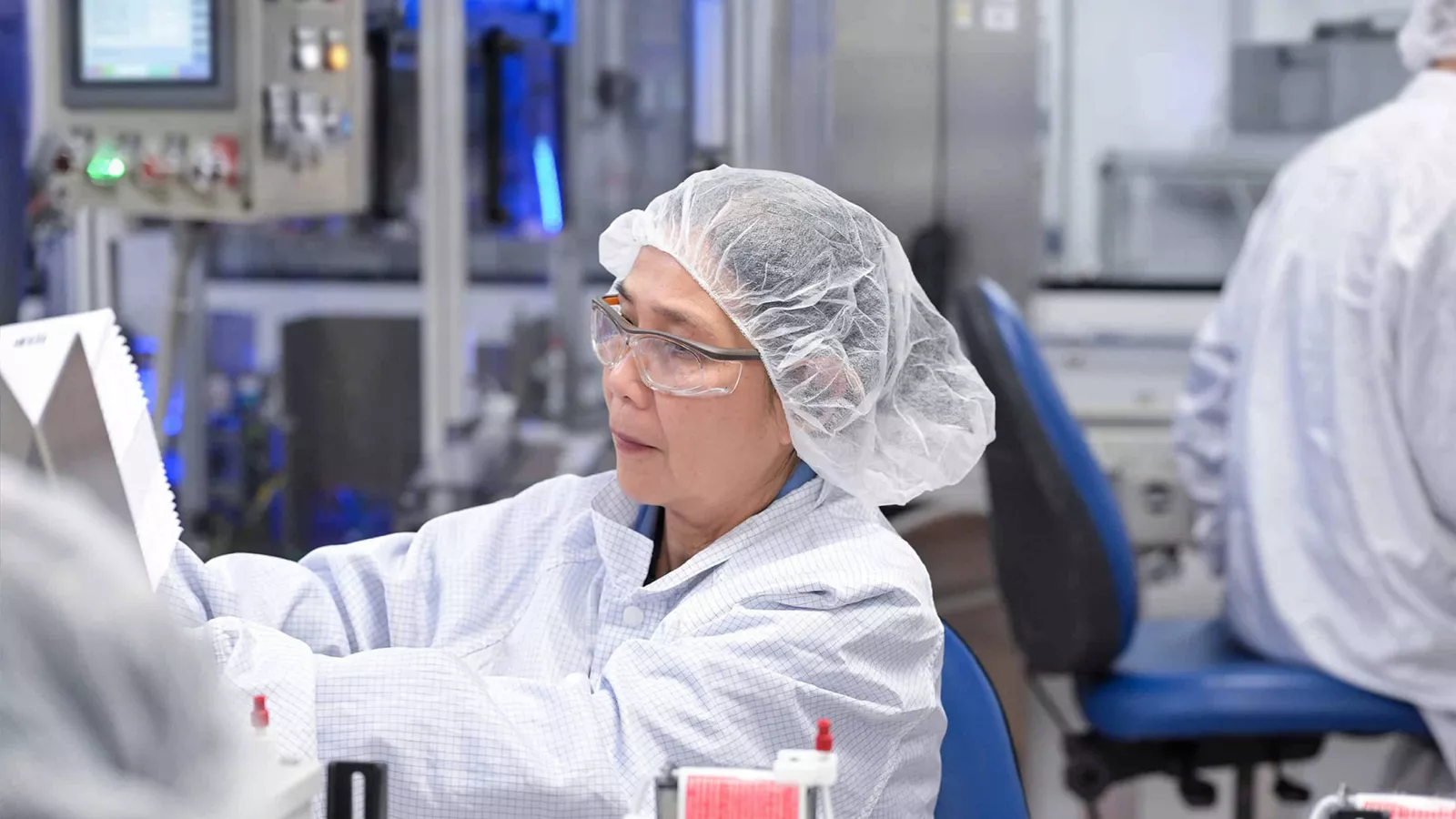
Step inside the “Factory of the Future,” where AbbVie is empowering skilled workers with advanced manufacturing technologies, including AI, to deliver medicines patients depend on.
Key Takeaways
How AbbVie is delivering medicines faster and with high quality:

Using robotics, artificial intelligence (AI), vision systems and data analytics to help make manufacturing smarter and more efficient — while freeing workers for higher-value work.
Transforming factory roles into tech-forward careers built on human skills such as problem-solving, critical thinking, creativity and collaboration, supported by training and employee-led innovation.
The result: Faster delivery of the medicines patients need, with the quality and care they count on.
When patients hold their medication, they may often see more than just a box or a bottle. They might feel the weight of their entire health journey. And they may find reassurance in the fact that, as they continue managing their condition, they’re not facing their journey alone.
But what they don’t see is the advanced technology that brought that medication to their hands. Between the lab, the manufacturing facility and their doorstep lies a network of advanced automation, digital tools and teams of skilled professionals, all working in concert to help seamlessly deliver that medication.
Making that reality possible is AbbVie’s “Factory of the Future” — our investment in the evolution of manufacturing, where powerful technology and human expertise come together. This transformation is happening right now: Over the past 12 months, AbbVie has committed more than $2.2 billion to U.S. manufacturing, building the latest technologies into every new facility from day one and creating more than 1,300 high-value jobs across the country.
“I’ve always wanted to be in health care because of the sense of responsibility we feel toward the patients we serve,” says Hayk Grigoryan, the associate director of AbbVie’s Factory of the Future initiative. “There’s no compromise. No shortcuts.”
Here are five technologies driving this transformation, and what they mean for patients and employees:


Robotics and automation: Beyond the assembly line
For decades, factory robotics followed a familiar pattern. Machines were arranged in a straight line, each performing a single, pre-programmed task in a rigid sequence. But that model is giving way to something far more sophisticated, says James Hughes, vice president of operations, AI and digital transformation.
At one AbbVie factory, a newly developed “robotic island” reimagines the entire workspace. Robotic arms operate from the ceiling, the floor and the sides of a large rectangular cell, moving in coordinated patterns that cannot be achieved in a traditional linear setup. Hughes says it’s already delivering remarkable results:
- 70% less time spent reconfiguring production lines between product runs
- 50% improvement in how quickly finished products are ready to ship to patients
- The elimination of manual tasks in a packaging line
The next evolution: Adaptive automation
These systems are also growing smarter. Equipped with vision technology, the most advanced robots can “look” and plan their most efficient movements. “We won’t have to tell the robot exactly how to pick something up or place it down,” says Hughes. “Instead, we can give it an end goal, and it can decide the best approach in real time.”
But the most significant shift isn’t technological — it’s human. Rather than displacing workers, these robotic systems free people from repetitive or physically demanding tasks. Instead, people can focus on work that only humans can do, requiring judgment, creativity or problem-solving.
“I don’t want a person to have to pick up a bottle and move it to another place,” says Steve Franklin, vice president of operational excellence and training. “I want that person to understand how to get that bottle to the patient faster, how to ensure 100% quality is built into it, and how to make the process error-proof.”
Joe Brodt, a digital transformation manager, also sees new possibilities. “I want to empower my colleagues to latch onto new skills and keep learning,” he says.

Be Part of the Factory of the Future
Picture yourself on a team where technology and talent come together to help deliver for patients.
AI: From data overload to insight
AI has become a daily presence in AbbVie’s manufacturing operations — not as a replacement for human judgment, but as a tool to amplify what people can see and understand.
“There’s not a day when AI isn’t part of our conversation,” says Grigoryan. He describes using AI in three distinct ways:
- It analyzes massive data sets across projects, surfacing insights and patterns that would be hard to spot manually.
- It operates in a predictive fashion, using maintenance logs, for example, to give shop floor teams proactive information about equipment needs before problems arise.
- It guides robotics and automation systems by using real-time shop-floor data to help optimize operations on the fly.
One exciting pilot is WRAP (Whole Room AI Platform), which will act as a “digital twin” of a manufacturing space. Factory staff can use it to verify that the space meets all required standards before operations begin.
Building AI with employee input
To Eimear McCarthy, director of Factory of the Future transformation, AI is also critical to the employee experience. “We are so used to using AI apps in our daily lives,” she says. “People expect to work at a place where we have the latest tools.”
To ensure these solutions meet real needs, AbbVie is directly involving employees at all levels in shaping the technology roadmap. Teams bring together cross-sections of staff for workshops, showing them potential AI solutions and asking, "Would you use this?" Where do you see this fitting into your daily life?” That input guides the roll-out of new AI tools.
Vision and video systems: A new view on precision
In certain manufacturing processes, human hands remain irreplaceable. Complex manual assembly tasks, like making some types of medical devices, require dexterity and judgment no machine can fully replicate. But even skilled workers face a challenge: intricate tasks are prone to errors.
AbbVie’s answer is a real-time manufacturing co-pilot, which is mounted above the workstation. “It projects down onto the table a picture of the steps a worker will need to take when they’re assembling the product,” explains McCarthy.
Equipped with AI-powered vision models, the co-pilot system monitors progress as the worker puts each component in the right place. All the while, the co-pilot is comparing every step against a reference image. If something doesn’t look right, it’s flagged immediately. “It checks that you’ve done things correctly, and it can really help with those guided steps,” McCarthy says.
Replacing paper with pixels
This visual approach extends to training materials, which are often dense manuals of standard operating procedures that workers must consult mid-task. To help, AbbVie is building a solution called “digital work constructions.” These clear, visual instructions and videos can be called up at the exact moment they’re needed, replacing thousand-page documents with on-demand, task-specific guidance.
Data & Analytics: Connecting the dots in real time
Every second, AbbVie’s manufacturing equipment creates data — thousands of pieces of information tracking things like temperature, pressure, speed and quality. The challenge isn’t collecting that data. It’s figuring out what it all means.
To do that, AbbVie built a shop floor integration layer, a software system that connects all the equipment across packaging lines and pulls data from dozens of machines into one place. Before, engineers had to download data from each machine one at a time, spending hours organizing spreadsheets just to understand what was happening. Now, dashboards show that information in real time, displaying things like uptime, downtime, reject rates and how equipment is running.
“We have phenomenal people here,” says McCarthy. “I don’t want a really smart engineer or scientist spending 70% of their time manipulating data. I want them spending most of their time understanding the problem and trying to devise a solution or a better way of doing it.”
The system allows for other important improvements:
- Recipes for a batch of products can be selected and sent to the equipment from electronic records, removing the chance for human error.
- Reports can be put together and sent to the cloud automatically instead of requiring engineers to download files from machines individually.
- Centralized systems can control several machines from one touchscreen.
Adding intelligence to the data layer
Layering AI onto these dashboards can allow for even more advancements, says Brodt, the engineer. For example, an AI assistant could help him understand what’s most important as he reviews a morning report.
“AI can not only help me understand what lines ran well or ran poorly last shift. But it can be a thought partner to say, ‘Hey, look at these three things,’ as I decide how to increase that performance.”
Workforce enablement and training: Investing in people
Advanced technology requires skilled people to use it. That’s why workforce development sits at the heart of the Factory of the Future initiative, ensuring employees have the training and opportunities they need to grow alongside the technology.
Building careers from the ground up
At AP16, AbbVie’s North America Packaging Center of Excellence in North Chicago, Illinois, site head Kai Welzel has a clear philosophy: “What truly makes this site special isn't just the systems — it's the people.” To back that up, the site runs five programs spanning recruitment to career advancement:
Bringing talent in:
- Early Technical Talent Program: A partnership with local high schools to recruit graduating technical students directly onto AP16's production lines, setting them on a path to meaningful, tech-forward careers.
- Technical Development Program (TDP): A rotational program that brings college-level technical talent into the site, building a pipeline of versatile, developing professionals.
Growing talent already here:
- Production Technician Training Program: Hands-on technical training taught by internal and external partners.
- Technical Certification Program: Four industry certifications offered in partnership with the College of Lake County.
- Operations Pathways Program: A program for floor-based employees to earn a college degree while rotating through roles tailored to their goals. Launching in 2026, the program will also be open to current degree holders looking to accelerate their careers.
A culture of continuous learning
Beyond formal programs, learning is woven into everyday work. One new resource is the Data Academy, available on demand to all operations employees. It offers 90 microlearning courses across seven tracks, and it’s continually updated with new material. Employees are already using it in creative ways. They're taking short courses together at lunch-and-learn sessions, “upskilling” on their own schedules and sharing knowledge across teams.
Also in North Chicago, AbbVie built an on-site training laboratory where instructors teach employees not just how to operate equipment, but why they’re operating it that way and what troubleshooting skills they’ll need. The skills being developed — analytical thinking, problem-solving and decision-making — are now essential at every level, from shop floor to senior leadership.
The investment in people goes beyond coursework. “Everyone we engage with is excited by this journey,” says Hughes. Operators now help design and implement solutions, he notes. Engineers connect data systems and then ask: Where else can we use this technology?
“The people engagement piece is the part I’m most proud of,” says Hughes. “The Factory of the Future isn’t just a technology solution. It really has become a business solution for people.”
The mission behind the machines
Beyond the sophisticated technology, this transformation serves a bigger purpose: getting medicines to patients faster, without fail.
Brodt has worked across the globe on nearly every product AbbVie manufactures. Among his family members, coworkers and neighbors are people who depend on the medicines his teams produce. “I can confidently sleep at night saying, I know that I gave them a product with quality built in,” he says. “If I can make somebody else’s life more comfortable, or they can enjoy it with their family more, that’s what inspires me.”



Unless otherwise specified, all product names appearing in this internet site are trademarks owned by or licensed to AbbVie Inc., its subsidiaries or affiliates. No use of any AbbVie trademark, trade name, or trade dress in this site may be made without the prior written authorization of AbbVie Inc., except to identify the product or services of the company.
Copyright © 2026 AbbVie Inc. North Chicago, Illinois, U.S.A.
